



Javelina Jundred flexes to show again why its the largest jundred miler in the United States.
It’s safe to say trail running is no longer a niche sport. Recent studies estimate it as a $20 billion global industry, and while professional trail runners still lag behind their marathoning counterparts in prize money and sponsorships, that gap may be closing. As the stakes rise for the sport’s upper echelon, it feels almost inevitable that one day the elites may compete separately from the masses.
[Salt Lake Foothills Trail Races | 30 May 2026]
We talked about this in the lead-up to UTMB with Abel Recknold, team manager of the Craft Elite Run Team. With sponsorships, media rights, and Golden Tickets on the line, you can imagine a near future where the pros start in their own race and where crew access and livestream control push the sport toward a more structured, exclusive model.
Start here:
The Heart of Ultra Running,
Open Letter to RECCO,
Emory Atterberry
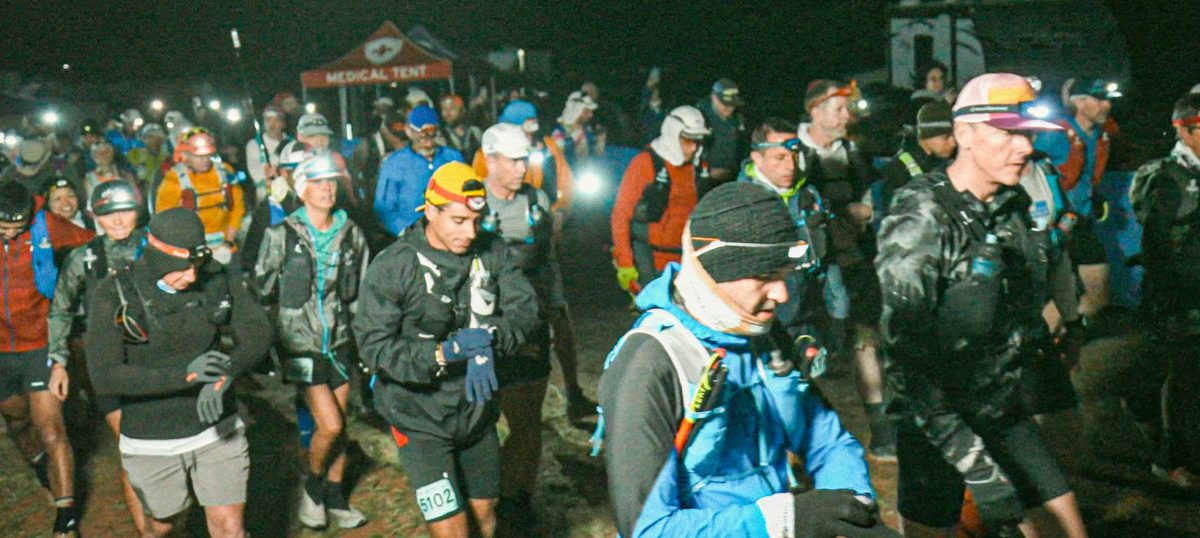
But just when that starts to sound reasonable, the Javelina Jundred rolls around—a costumed spectacle outside Phoenix that defies the logic of modern sport. The race is a hundred-mile party around a 20-mile desert loop, and yet it’s also one of six HOKA Golden Ticket events for the 2026 Western States 100. The top two men and women earn automatic entry to Western States. On paper, it sounds absurd. In reality, it’s what makes trail running special. Javelina Jundred is proof that competition and community can still share the same dirt.
Carnage and course records
The 2025 edition produced both. That’s the pattern now in elite ultrarunning—athletes push so hard they either destroy records or self-destruct trying.
[Javelina Jundred | Brutal Race]
Under favorable conditions, Will Murray won in 12:10:12, breaking Jonathan Rea’s 2023 course record of 12:43:10 by more than 30 minutes. Behind him, David Roche (12:18:06) and Canyon Woodward (12:19:59) rounded out a podium that showed both the sport’s depth and its direction. Roche, just over two months after breaking his own Leadville 100 record, looked composed even as he later said he went “non-verbal for 50 miles.” For Woodward, it marked the culmination of five years of patient, incremental work.
On the women’s side, Tara Dower ran the race of her life, finishing in a course record 13:31:47, a time that would have won many years at Javelina Jundred outright. Beth McKenzie (14:31:14) and Addie Bracy (14:45:02) followed to round out the podium. Because McKenzie previously served a two-year doping suspension from 2016 to 2018, she’s ineligible for entry into Western States under the race’s anti-doping policy. McKenzie still maintains her innocence, but the second Golden Ticket nonetheless rolled down to Bracy, who accepted it on stage.
The mentor and the pupil
Few moments captured the heart of Javelina Jundred better than what unfolded on stage after the race. David Roche had just finished second, running 27 minutes faster than his own winning time from 2024. But when it came time to accept his Golden Ticket to Western States, he chose not to take it. Instead, he passed the opportunity to his athlete, Canyon Woodward, who had finished just behind him.
Roche has coached Woodward for five years, watching him improve roughly five percent at a time, season after season. On Saturday, that steady build met its moment. Their exchange wasn’t rehearsed or performative. It was quiet, genuine, and entirely fitting—a coach stepping aside so his athlete could take the next step.
The runners we kept coming back to
We followed four athletes into Javelina Jundred—Sage Canaday, Careth Arnold, Clint Anders, and Caleb Bowen—each with their own version of unfinished business.
Sage Canaday’s day was the kind that reminds you why the sport still matters. Four years after a pulmonary embolism nearly ended his career—and three years after losing his home in the Marshall Fire—he returned to the desert and finished in 13:34. He went out fast, set “trail PRs” through 50 miles and 100 kilometers, then fell hard and bonked in the late stages, battling dehydration and nausea for the final lap. But he never quit. Pacing help from his partner, Sandy, carried him through those last 20 miles. For a runner who’s given two decades to the sport, the finish wasn’t about time—it was about gratitude, resilience, and the quiet satisfaction of still being out there.
Arnold’s race ended early. The body wasn’t right from the start, and by the second loop, she knew it. She described it later like a car running out of gas—bursts of life followed by stalls and silence. The decision to stop wasn’t easy, but it was the right one. Coming off a season that included a historic American win at TDS, she had nothing left to prove, yet she still showed up ready to test herself. That’s the part that stays with you.
Anders went out smooth and confident. For a while, everything clicked, until the desert heat and low sodium caught up to him. By the third loop, he was walking the climbs, troubleshooting with friends, and watching the race slip away. He made the call after loop three, old injuries whispering reminders. On paper, it’s a DNF. In person, it looked more like perspective.
Bowen was the steady one, a man who knew exactly what he wanted out of the day. After running 14:20 last year, he came back and dropped his time by seventy minutes. Fifth place this year would’ve won in plenty of others. It was a perfect reflection of his quiet, efficient, and methodical approach to the sport
Not all stories end the same way, but together they gave Javelina Jundred its shape: joy, failure, resilience, and the strange sense of gratitude that seems to live in the middle of all three.
The heart of it
When Murray broke the tape, it confirmed what the front pack had made clear all day: ultrarunning is evolving fast. Training, fueling, and pacing are sharper than ever. But what Javelina Jundred proved again is that speed and spirit still coexist.
The race delivered everything the sport’s future might demand—records, precision, data—but also everything its past still protects: grit, camaraderie, and a sense of play. You could see it in Sage Canaday’s steady return, in David Roche’s grace, in Canyon Woodward’s moment, in Clint Anders’s willingness to test his edge.
For all its noise, Javelina Jundred remains one of trail running’s clearest mirrors. Beneath the costumes, heat, and chaos, it reminds us why the sport still feels different. It’s not about metrics or money. It’s about people chasing something hard together—and walking away changed, whether they finish or not.