
This episode is from the Borderlands Trail & Ultra Running Podcast.
Episode Summary
Lazarus Lake, born Gary Cantrell, stands as one of the most iconic figures in ultra running. As the race director and creator of legendary events like the Barkley Marathons and Big’s Backyard Ultra, he has reshaped ultra running with his unconventional, grueling designs that push human limits far beyond conventional marathons or even typical ultras.
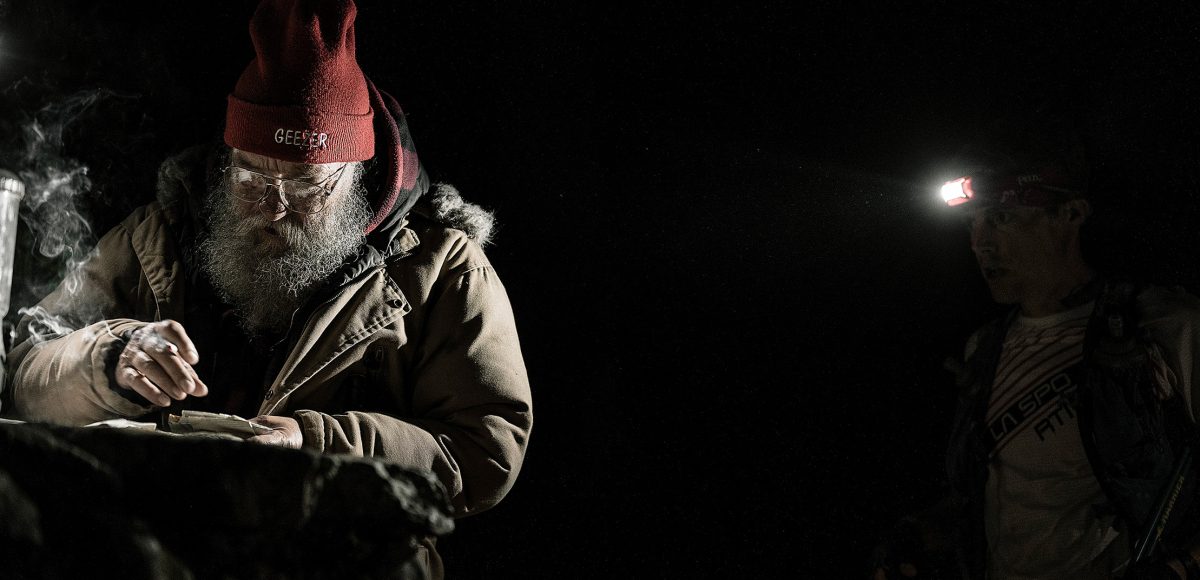
[photo credit Jacob Zocherman]
His races aren’t just tests of speed or stamina, they’re profound explorations of perseverance, mental fortitude, and the raw essence of struggle. The Barkley Marathons, held annually in Frozen Head State Park in Tennessee, demands runners complete five brutal 20-mile loops (approximately 100 miles total) within 60 hours, often with minimal markings, extreme elevation, and a notorious reputation where finish rates hover below 2%.
Big’s Backyard Ultra, meanwhile, pioneered the “last person standing” format, where participants run a 4.167-mile loop every hour on the hour until only one remains. These events have inspired global movements in ultra running, drawing thousands to backyard-style races worldwide.
Josh pays homage to Lazarus Lake through three symbolic artifacts, each revealing deeper layers of who this enigmatic man truly is and sparking conversations about his philosophy and influence.
1. Camel Yellows (00:28)
First, cigarettes [specifically, Camel Yellows]. Lazarus Lake is rarely seen without one, often lighting a fresh Camel to ceremonially start the Barkley Marathons with a puff of smoke signaling “go.”
This habit dates back to 1966, the same year he began running seriously. While many criticize the contrast between his endurance ethos and smoking, it underscores his unapologetic authenticity. He has never bowed to trends or health fads, staying true to his ways even as the world evolves. The cigarette becomes a ritualistic emblem, a quiet rebellion against conformity, much like his races defy sanitized, corporate ultra events.
2. Like the Wind (07:35)
Second, Like the Wind Magazine serves as a powerful analogy. Just as mechanical watch companies like Blancpain navigated the quartz crisis of the 1970s and 1980s [resisting the shift to cheap, accurate digital technology by doubling down on craftsmanship, tradition, and timeless quality] Like the Wind has charted its own path in running media.
Amid the digital explosion of apps, social media influencers, and data-driven content, the magazine remains committed to print, storytelling, and the soulful side of running. Lazarus Lake mirrors this steadfast conviction. He never succumbed to modernization pressures in ultra running—GPS tracking, aid-station excess, or commercialization. Instead, he clings to analog purity: hand-drawn maps, quirky entry fees (like license plates or a pack of Camels), and courses that demand intuition over tech. His events remain untouched by fleeting trends, preserving the raw, unpredictable spirit of ultra running.
3. The Old Man and the Sea (15:18)
The Old Man and the Sea by Ernest Hemingway. In Hemingway’s novella, the aging fisherman Santiago embarks on an epic, solitary battle with a massive marlin, enduring days of physical torment and isolation.
Though sharks ultimately devour his prize, Santiago’s dignity lies in the persistent, dignified struggle itself, the pursuit of meaning through unrelenting effort. Lazarus Lake embodies this archetype. He designs races that strip away comforts, forcing participants into prolonged, often futile-seeming battles against terrain, fatigue, and self-doubt.
The Barkley, with its infamous “quit” temptations and psychological warfare, teases out this same Hemingway-esque heroism. Every runner who toils through the loops, even those who fail spectacularly, gains something profound: validation in the struggle.
Lazarus Lake gifts ultra runners the opportunity to confront their own “marlin” to find purpose not in easy victory, but in consistent, stubborn pursuit amid suffering.
Through these artifacts Josh shows Lazarus Lake not merely as a race director, but as a philosopher of endurance. At nearly 70, Gary Cantrell (Lazarus Lake) continues to innovate, from his cross-country walks to evolving his events, all while staying true to his core. He remains among the most iconic figures in ultra running, a living reminder that true greatness often emerges from refusal to compromise, embracing the absurd, and honoring the eternal human drive to endure.
–
Chapters
00:28 Laz’s Relationship with Smoking
07:35 Untouched by the Digital World
15:18 the Old Man and the Sea
28:09 Light to the World Through Running
Links & Resources
Notable Lazarus Lake-related docs
the Finisher
The Barkley Marathons | The Race that Eats its Young
Jared Beasley + Laz Lake Interview
Related Episodes
The Last Rebel of Ultra Running | Lazarus Lake
The Future of Barkley Marathons | Lazarus Lake
Transcript
Show Full Transcript
0:02
I listen to an incredible variety of things, yeah.
Have you heard of Occitan?
Occitan.
It’s a Mongolian band.
Oh, Occitan, No, I have no idea.
The Borderlands Trail.
0:24
And Ultra Running podcast presented by Kip Run.
My name is Josh Rosenthal, the host and the founder.
Kip Run is coming to America.
The shoes released on April 6th.
I’ve been running in the trail and the road shoes.
I’m really happy, really grateful to be working with him because I really believe in the shoes.
0:40
I think he’ll be stoked on the shoes and the price point of them.
More on that US on April 6th in Europe.
Really any day now.
OK, this is the third and final interview with Laz.
If you want the full context, go listen to interview one or interview 2.
In those intros I give you plenty of context to prepare you for this this whole thing.
0:58
And here in the final one, I sit on Lazes porch to pay homage to him with three artifacts.
I I kind of think through what are what are three things that make me think of Laz?
That would maybe.
Bring out interesting conversation with the big one, the piester resistance being the old man in the sea, where we look at how Santiago finds dignity not in the outcome but in the struggle.
1:22
And I think Laz, perhaps that’s him personally with his trans con, but I think just as much as anything.
This is what Laz’s events.
Provide they they bring this to runners is this moment, this opportunity to see that the.
1:38
Struggle is the victory.
Not necessarily the outcome, which is good news because almost nobody finishes Berkeley.
I hope that you enjoy this conversation on all three of these as.
Much as.
I enjoyed having them.
It would mean the world to me if you would share these conversations with your friends who you think would like them, if you would leave a review, if you would leave a rating for the podcast wherever you listen to it, all that helps tremendously.
2:02
OK, here is maybe I think he’s my new friend.
That’s usually how I introduce these podcasts.
Here’s my new friend Lazleg in interview #3 the final one.
I hope you enjoy.
So as the this last piece here is about artifacts, it’s something that just for me personally, like I don’t like the tangible world is becoming less and less of a thing.
2:33
It feels like we’re so digital and we’ve kind of lost a lot of our sort of tactile and in person Ness and all that.
And which I do obviously clearly see you doing a lot of that.
I’m, I’m going to work through three artifacts here with you and just chat about them, see what you think.
2:50
So have you, so you say you’ve been to Europe.
Have you ever bought cigarettes in Europe?
I don’t think I’ve bought any, but I’ve had had European cigarettes.
OK so this these are the camel yellows I.
Get the ones from Sweden with all the.
All the graphics.
3:05
All the graphics on the front.
So on cigarette packs in in France and all of Europe, you can’t brand them, you can’t put a design on them.
You have to put some sort of image on it.
That’s a warning of why you shouldn’t do it.
And so I think it’s pretty funny.
So this is a dab blowing smoke in his child’s face and the child’s crying.
3:25
So not that anyone’s ever done that.
So there’s, well, I mean, I mean, anything’s possible.
I should say.
I hope that I don’t know anyone who’s done that.
So the first time that I ever had a cigarette, I was in fifth grade.
3:40
And I stole a pack from the corner store in Fort Worth.
And I went to a drainage ditch and into the tunnel with my friend Steve and we smoked a few and it was the worst experience of my life, but somehow came to enjoy them from time to time after that being such an awful experience.
3:57
Do you remember your first cigarette?
Yeah, I would have been 12.
Yeah.
And went to the filling station and bought them out of machine for 30 or $0.35 and.
4:13
Was this in Oklahoma or Tennessee?
Tennessee.
Tennessee.
Because we moved to Tennessee.
Seeing 12 year old kids smoking at that time wasn’t really shocking.
Yeah, this would have been 191966.
Yeah, it was.
So I started smoking and running the same year.
4:30
Hey Ben, can I get the pack?
By the way, smoking and running in the same year, did you smoke continuously through all of your running life?
No.
OK, no, I’ve through when I when I made the cross country team in high school, then I never smoked again until I was until obviously my career running in a school was over with.
4:52
I never even drank a a carbonated beverage the whole time really.
And then when I was really trying to still compete, I would, you know, I would not smoke for sometimes 6 to 10 months getting ready for a particular event.
5:17
But you’re always fortified with the knowledge that steps beyond the finish line, you were going to have a cigarette weight, the best cigarette you’d had in a year.
Did you the iconic lighting of the cigarette to start Barclays and all that was was that an was that an accident?
5:39
Like, I mean, was that like some grand design or just all of a sudden one day you did it and there it was.
We there was an epiphany for me in my 30s when one day it dawned on me just because I was told not to do something, yeah, I wasn’t obligated to then therefore do it that sometimes it was OK to say, yeah, that’s a really bad idea, I could die, but kind of thumbing my nose at authority.
6:13
It was was led to A to a rocky youth.
Yeah, yeah.
I mean, it sounds like.
If I was told you don’t, you not allowed to do it or you can’t do it, then by God, I was going to find a way to do it.
6:33
And as a as a youth, I was not.
I have scorn for people who vandalize things, tear things up, damage things.
But if you do something that does no actual damage, and when people come out in the morning and they see it, they go what?
7:00
Yeah.
One, why?
Yeah.
And two, how?
How’s that even possible?
Yeah.
That has some quality to it.
Right.
I always said that the sweetest words you ever hear when you’re in high school is we know you’re involved because it means 1.
7:29
You have a signature that this thing you were, you were involved you you were the one that has your.
Fingerprints on it you.
Thought of it, you figured out how it could be done, and second, they have no evidence.
Yeah.
7:49
We know you’re involved.
This sort of dovetails nicely into the 2nd to the 2nd artefact here, and that is.
I don’t always do those things anymore.
Yeah, always.
You don’t always.
8:07
OK, so 1981 Ultra running magazine starts in in you’re writing from the South from the first issue.
Yes.
They went around to races months in advance of coming out and they put Flyers out for the new running Ultra running magazine.
8:29
And I had, yeah, most of the time.
I’ve pretty much lived with a tight budget and my my subscription budget back then because every you couldn’t get things to read except on hard copy.
8:48
Yeah, my subscription budget was already pushed beyond the limit.
And so I thought, you know, I got to get this.
And so I wrote to him and I said, how about if I write an article for you every month for in exchange for a subscription?
9:07
I’d never written anything.
And it really showed, especially at first.
But what you do, if you’re smart, instead of griping about editing, you study the editing.
And that’s telling you, you know, what you need to to square up and tighten up on.
9:28
Well, knowing that you know, doing some research on that you’re doing this writing reminded me of another story.
Mechanical mechanical watches had this great movement.
Where can you say that lighter this great movement and I.
Have another. 10 you got the hyper light lighter that’s here.
9:46
I’ll trade you so there was this great.
Do not put that in your pants pocket and swim.
I wasn’t planning on it, but now I’m absolutely not putting on.
It now you’re not going to do it.
So when quartz movements were introduced into watches, mechanical watches, which were very expensive, very complex, been made, you know, for a long time, maybe I’ll miss some details here.
10:10
The 70s or 80s, every major watchmaker in the world went to quartz except for there was one of note that didn’t.
And they stayed making mechanical all the way through what they called the quartz crisis, because Rolex put a quartz in a watch and and all of these great brands were putting a quartz in a watch.
10:29
The parallel here is that this tactile sort of life, everyone went digital.
So we lost print and everybody, every magazine, every publication went to some form of digital and abandoned their sort of mechanical, their tactile, you know, the magazine in hand.
10:48
This is a magazine called like the Wind.
It’s my favorite running magazine.
And they were, they were conceived and started in, in that digital, in what we call the digital crisis.
I guess if there was a quartz crisis, it’s just great stories about why people run.
11:03
It’s, it’s not like a runner’s world or anything like that.
I’m huge fan of it, but I think it makes me think of you in a lot of ways.
Is that you’ve been putting on racist since 1979.
There have been all of this professionalization of the sport like we’ve talked about in other conversations and you have sort of navigated and stayed the course not by maybe some design of your own.
11:27
It’s just who you are.
And you know.
Yeah, I think I think I just, I think I just want to acknowledge that.
So this tactile piece here of saying you navigate the digital crisis, the courts crisis and you, you the, the last that’s sitting here is probably very similar to the last of 1979.
11:46
Yeah, I think so.
Maybe mellowed a little.
Tell me about that.
So it’s ironic you started with watches because the advent of the digital watch was for such a such a breakthrough, because the mechanical watches on your arm when you run, if they live a year, it’s a miracle.
12:13
Yeah.
Because on those mechanical works is just way too much stress and they they just give up the ghost.
Yeah.
And so my first digital watch was a handout at a baseball game, huh?
12:32
And a.
Professional baseball game.
Well, the minor league in the Nashville Sounds and they gave everybody a watch and then I found I could buy a watch like that for like $2.00 and it would run for years before the battery finally died.
12:51
Now they’re they are recharge their battery, their solar power.
So just so you you keep them until the rubber band around your wrist breaks and then it’s cheaper to just get a new watch than it is to replace the band.
13:10
Yes, Yep.
Yeah, kind of crazy.
The old ones, it was cheaper to get a new watch than to replace the battery.
Yeah, so I my most expensive watch I’ve ever worn since then was like $11.
So I you.
13:26
Very much, you know, I think some people at some point came to confuse punk rock with how you dressed and not how you think.
And I you have this punk rock air about you.
But like in 1978, were you listening to The Ramones?
Like what music was going on with you then?
13:43
Were you country guy?
No, well, not today’s country.
Some of the old real country was OK.
And I go back and forth.
I listen to an incredible variety of things.
Have you heard of Akiten Akiken?
14:02
It’s a Mongolian band.
Oh Akiten, no, I have no idea.
You haven’t seen them?
No.
I’ll look into it.
It’s it’s like it’s either OK YTEN or OTYKEN.
14:19
OK, I bet Google will help.
I’m sure you can find.
I’m we’ll listen to it when we drive away.
And then I’ve hit a stretch of the the the newest music.
I’ve stumbled across something at Chasing Abbey.
14:38
OK, it’s an Irish band, OK, but they only have one song with different words.
It’s really good.
Is it just like an old Irish like traditional?
No, not.
Exact form or?
Chasing Abby, that’s got some really good.
14:56
They got some really good songs.
OK or a really good song and really like industrial.
OK, A.
Lot of Skinny Puppy.
OK, heard of Skinny Puppy?
Definitely heard of Skinny Puppy.
And try to try to remember the names of bands.
15:16
I’m not.
That’s like books.
I can’t remember who they’re.
Well, are you?
Are you a reader?
You like to read books?
Are you?
Do you like?
Yes, I’m going to have to have cataract surgery so that I can read faster because it’s too much of A struggle now.
15:33
Yeah.
And I but now there’s so much to read on the Internet.
When you were a kid, you would think of things that you wonder about and you write it down on scraps of paper and stuff them in your pocket.
But I had to wait till you went to the library and then you could go to the resources and track down some material on that topic now.
15:58
And most of those scraps of paper just died unused because you simply, it was too slow of a process.
Now you have Google, except Google has plummeted in value because of AI.
Right.
16:14
Which doesn’t give you reliable answers.
That’s right.
But you learn how to how to detect when you’re getting an AI answer and get around that and go to an actual source.
And then because every time you answer a question, every question you answer raises 20 more questions.
16:37
But you’re just sitting there, effortlessly going from place to place until you get a much more complete picture.
You know it’s.
So yeah, I with all my childhood, I was got in trouble for reading.
16:55
Really interesting because you’re supposed to be doing something else.
No, because when I there was, there was a variation.
Miss Bell, my third grade teacher, bragged the high heavens about my ability to to concentrate to or focus.
17:14
Now, you would call it focus.
Yeah.
Your parents, most teachers, most everyone doesn’t like the fact that if I started in that book, if I started reading an article, everything else would cease to exist.
Right, I get it.
17:33
Immediately and and I was insatiable.
Yes, yeah.
Have you read any Hemingway?
Are you a Hemingway fan at all?
I’ve read AI don’t much read fiction type.
Really I only have recently got into it this.
17:49
So the, the, the final one here, it’s going to come with a bit of a presentation because I’m going to, I’m going to kind of give you the high level of the book and I’m going to tell you why it made me think of you.
So is that the old man in the?
Sea.
It’s the old man in the sea.
I managed to dredge through that in high school.
But I read it for the first time last year.
18:05
So I live in Paris, in the, in very close to where he lived in Paris.
And he wrote books about where he lived in Paris and all this.
But I just not everything about him, of course, is admirable.
But the first thing I ever learned about I was I was in Ketchum, ID.
18:21
That’s where he’s buried.
That’s where he committed suicide.
And so I saw his grave there and in O5 on my honeymoon with my wife and I’ve just sort of been interested in for a long time.
But now we live in the neighborhood that he was in, in Paris.
So the old man in the sea is about an old man and A and a younger man.
18:40
Santiago’s the old man Mandolin is the son there in Cuba or not?
Not his son, the younger, the younger kid.
And he is an out of luck fisherman.
It’s been 80 plus days since he’s caught a fish.
And that’s life on this where they live is catching fish.
He’s gone 80 plus days without catching a fish.
18:57
And so Mandolin’s parents say you can no longer hang out.
You can no longer go fishing with Santiago.
So Santiago’s sad because he and this boy had become close.
This boy helps him.
He’s he’s an aging old man.
He shouldn’t really be out fishing on his own.
He goes fishing on his own because Mandolin can’t come.
19:13
And for the first time in 80 something days, he catches a Marlin.
But he’s out there alone.
And so he fights with the Marlin for several days and he finally reels it in.
He’s he’s bloody the the fishing line, everything is cut through his hands and he’s just really beat up.
But he pulls it in.
And so for the first time in 80 plus days, he kind of regained some of his dignity because he can catch fish again.
19:35
Well, as he’s hauling the man, the the Marlin back, the Marlin gets eaten by the other fish in the sea that he’s taking it back.
So all he brings back is a skeleton of a fish.
So he he brings, he has nothing to bring back.
19:51
But OK, so here’s what I love about it.
Hemingway believe that life is full of things that are bigger than us, things that are out of our control, nature, age, death and luck.
And so this was the things that you can’t control nature, age, death and luck.
You can’t control those things.
20:07
But what you can control is essentially the.
What’s inside and how you respond to those things.
So Santiago returns and he’s he’s proud of the Marlin, but he has no Marlin, truly.
He just has a skeleton of the Marlin.
But what he did was he proved only thing he did then was he proved himself to himself.
20:27
He didn’t.
He didn’t.
Crossing the country.
Exactly.
So here we go.
This is.
This is where it ends in victory lies in the struggle and not the outcome.
This was the moral of the old man in the sea is that he was not able to bring meat, you know, back to the village.
20:44
He wasn’t.
It was purely he went out as an old man and and regained the dignity that he had lost and was by being an incapable fisherman.
So much so that he lost this kid that meant so much to him because he was such a bad fisherman, and then his parents let him fish with him again.
21:03
But the moral of the story was victory lies in the struggle, not in the outcome.
And I think that your events, to me remind that’s what makes me think of that more than anything else.
What you construct, whether it’s by by design or by a bonus, I just feel like for someone to run your event, that’s what.
21:25
But your events are uniquely that compared to anybody else’s.
Well now see, I’ve never seen that compare or heard that comparison or thought about it.
I shamefacedly admit I read that book in high school.
21:41
Is it a book or just?
A short story.
I mean, to me it’s a book because I’ve never been a great reader, but it’s they would call it a novella, I think.
I don’t even know entirely what that means, but yeah, it’s 100 pages.
It’s my reading we moved a lot.
21:56
Yeah.
So everywhere we went, I got a weekly trip to the library.
And so there were two things to do right away.
One was to convince them to let me check out twice as many books as they normally allow, and the second was to convince them that no, I know the children’s books are over there.
22:23
Those are not the ones I want to read.
Yeah.
And then when I pre Internet while living in Memphis, I read my way through one library branch after another.
You just go in and you go through and you pick all the books that are going to be good to read and you haul home a pile every week and read them.
22:44
And but all the books with feelings and stuff like that, I was down with by the time I was like in junior high.
Well, it’s funny, all the books that I so when I when I moved to Paris, I actually had time to read because I was having to take my son to school and he was so far, he’s on the other side of Paris from where we lived.
23:04
And so I could read on the bus and all of the books.
So I was going to read all of the books that I was either assigned as a kid.
I never read one book that I was assigned in school.
And so I, I went back and I just wanted, I started to go through all those and I, and I started, you know, as a 41 and 42 year old, they’ve just meant a lot to me.
23:22
I’m about to finish Lord of the Flies, which most people read that when they’re a kid.
Yeah, I read that.
The Great Gatsby, Brave New World, all of these books are actually unbelievable.
And I I mean, I just, I’m shamefacedly had always thought that there was nothing possibly that could be in there for me.
23:40
But, you know, the the reason that they have, the reason they’re being assigned, at least if we’re being generous, is because they do have so much in them and they, you know, yeah, we’re being a scientist because there’s something to pull out of them.
But I never did.
And I mean, I never read one single book in junior high school.
23:56
Oh man, I just read books and books and books.
And when I lived in Memphis, I worked at the hospital and it was a, it was Baptist hospital in Memphis, which was connected to UT medical school.
And you basically staff a hospital for the morning and, and the evening because when, when everybody gets up, they all need to poop and they need to poop when they need to poop.
24:28
And you need to have enough personnel on hand to help everybody get through that part of the day.
So and the, the census went up and down and the, and so I was getting those piles of books from the from the library and take them in because of the type of books I liked.
24:47
Lots of medical students also worked as orderlies as, as their job.
And so everyone assumed I was a student.
And so I was left in peace to read and and was able to read vast amounts of material.
25:08
Yeah, I think if I were to summarize the day here, I think this victory lies in the struggle and not the outcome.
I, I, I feel like that’s, so this series that I’m in right now with the media that I’m doing is looking at the, the solstice.
25:27
I’m doing it like through the four turns of the year, the two solstices and the two equinoxes.
And right now winter solstice, it’s a time, it’s, it’s this season now.
We’ve moved in the season where there’s more light today than there was yesterday.
Thank God.
Yes and so I what I’ve done now is I’ve been interviewing people who I believe are bringing light into the world through running and so you you do that.
25:53
You know, not only are people do people like you and they like your events.
I just think that whatever you’re architecting, whatever you’re masterminding, whatever you’re doing, it’s not good for the world and I think I just wanted to acknowledge that and that’s that’s why I travel to get here 36 hours.
26:10
I’m in Tennessee for, I don’t know, 20 hours and I’ll travel 36 hours back home or whatever, but just it’s an honor to get to do this with you.
Well, I, I appreciate that.
I don’t, I don’t know that I figured that, but I’m got to go up, I’m going up to Canada and I’ve got to do a talk, which I’m not good at, but it’s just something you can, can try to learn.
26:40
But it’s for a guy who’s a volunteer and he’s like volunteered all along.
So I read up on his, his, his story and thinking how similar it is that from, you know, you don’t start out who you end up to be in the path that you take.
27:00
There’s a lot of similarities and, and one big part of it is that you learn from all these people when you’re when you’re young and that time between when you’re 18 and know everything and when you’re 32 and realize really how little you know.
27:22
But but people that have been there before and you pick up and in the end people say, oh, you’re full of wise stuff.
Well, no, it’s all stuff that that someone else taught me.
They’re just gone.
And you think that you’re more of a conduit.
27:38
You’re you’re carrying it along.
It’s but it’s a matter of having be willing to enjoy yourself.
There’s a there’s been tremendous pleasure in all the things I’ve done in my life.
It requires you to to get off the sofa.
27:55
And you know, I haven’t done, except for ball games, I don’t see very much TV.
Yeah, I like to turn it on and have noise in the background when I’m working.
28:10
Because quiet.
Quiet is is disturbing.
It doesn’t.
You can’t concentrate when it’s quiet.
Yeah.
But yeah, it’s it’s pleasure seeking.
Yeah, well.
Then you see that you get to see the people do things because I another thing that that really stands out to me because so often people say, well, what you know, you’ve seen all these great runners and I know what I’m doing is nothing or you’ve you’ve gone so far and this is my first 50 miles.
28:49
Yeah.
And he’d say no, what keeps it fresh is not the people that have done it over and over till it’s Rd. repetition and they never push themselves and they make sure every time they start that they’re going to finish.
Yeah.
It’s the person doing it for the first time, the person breaking new ground.
29:06
Yeah, the people at the Val State that never dreamed that they could cover that kind of distance.
And once they get out there, they spend most of their eight or ten days not thinking they’re going to make it.
29:26
It seems impossible, but they don’t quit and they hang on.
And then they’re finally comes a day that they realize I’m going up Sand Mountain.
I’m, I’m, you know, for the last 8 1/2 days, all I’ve wanted in the world is for this to be over.
29:44
And I’m maybe an hour, an hour and a half away.
Why am I sad?
Because at the same time, they’re so excited and they, they hit that rock and they can’t believe they did it.
And then at the the fall classics, a good one in the Val state, any of them, the redemption runners, they came, they were prepared for the level of challenge that you typically get, which is like, we want to target, you can get and they fail.
30:18
And it’s not like people think, oh, we can’t let anyone fail because they’ll give up.
No, failure is what makes people try and they go out and they hang at the BFC thinking of Ben hanging his, hanging his dog tag that you get for dropping down to the marathon, which is ADNF and hanging on his mirror, looking at every day for a year and coming back and finish.
30:46
And he’s he’s finished it 9 Times Now.
But he said then he said, you know, it made me a better runner because I had to change what I viewed as as a good performance.
31:03
It wasn’t, it wasn’t enough.
Just it’s, it’s the the race is devised to where you can’t screw around.
You got to run when you’d rather walk.
You’ve got to walk when you’d rather sit down.
You’ve got to push yourself when you want to, when you want to give up.
31:21
But then when people finish, it means something because they paid for it.
I think about my wife and I lately and we have a six year old, 9 year old and 12 year old and we’ve both in the last last week we’ve kind of both had this moment of we’ve been wishing away their childhood to some degree and don’t.
31:43
Worry it’ll be gone really soon.
You know, as they’re older and we’re starting to look at them and we’re like, Oh my God, like it’s that same thing.
It’s like we’ve been going for a long time.
You know, 12 years feels like a long time.
And now we’re thinking, Oh my God, he’ll, he’ll be.
And I’m and he will be, he will be gone in six years.
32:00
He will move out of my house.
And you hope.
No, he will.
He stick.
With that, yeah, he will.
He will go.
And it’s at, you know, I’m starting to feel like, oh man, I’ve wished it away for so long.
And now as I it’s far enough away to where I feel like I can course correct a little bit and stop wishing it away.
32:18
But at the same time, there’s just this, this heavyweight of like, you want this thing, you think you want it to be over.
And then you maybe can kind of see the finish line and you think, I don’t want this to ever end, you know?
You, you, you do go through a period at the end when you have too many adults in the same we’re under the same roof.
32:41
Yeah.
Especially when they go off to college and get to be independent and then come back.
Come back for summer.
And it’s just, and it’s this if they the after college looking for the first job.
32:58
And of course this is a first world problem.
It’s not like that we live.
It’s not like we were in a place where what, you got to go out and get a job and pay your share household budget or we can’t feed you.
Right, right.
33:13
And but and he did work, but there he was.
And you just, you just kind of grate on each other.
Yeah.
And one day they get that job, they find immediately find a place to go because they’re no happier having too many adults under the same roots.
33:29
That’s a good, that’s a good perspective.
And as the day that they take all their stuff and get in the car and leave, they become the most welcome visitor that you’ll ever have.
You can’t wait on them to come back and see you.
Just as long as you don’t have to live together every.
33:48
I, I have this memory of my dad when I moved off to Salt Lake and I just wanted, you know, I just wanted to get away because you’re exactly right.
Two adults like I, I’ve been, I was totally financially independent from 18 on.
And I remember coming back to visit one time and my dad, the living room light was on and the light was kind of at the back of the room.
34:06
So when I pulled up and it had been a year and a half since I seen my dad, I watched his silhouette run across the house.
You know to come outside.
And yet the day you left, it was like.
Yeah, probably for like a week and a half because when we when we would fight.
34:22
We would fight God.
Yeah, yeah, exactly right.
And then there’s the last stage, which we’re in now and we have football Saturday.
That’s our big because we both love to watch football and we we watch the same game, but we’ll also watch games.
34:40
And he’s watching it at his house and he was watching, I’m watching it here and I’ll get my phone and text to comment on something that just happened.
Hit send.
And it Dings when he sent the exact same comment to me that we were typing the same thing simultaneously.
35:01
Well, victory lies in the struggle, not the outcome.
And I think you, you, you, like Hemingway, have have communicated that in your own way.
You make me feel like a classier guy because all this highbrow literature was behind me now even though they taught it to me in school.
35:19
Yeah, well, don’t forget we are in the we are in the hill.
Are we hillbillies?
What are we right now?
We’re out here in the country, in Tennessee.
Well, thanks, Laz.
Not a lot.
Appreciate you’re here.
Salt Lake Foothills show races is back.
35:34
On May 30th, 2026 for the fourth year of super hot running with lots of gain and a growing party at the finish line.
This year we’re adding a 50 Miller on top of the 50K half marathon and 10K.
This year we’re adding prize money for our elite friends who want to join.
35:50
But it’s not just about the elite, it’s about everybody.
We celebrate everybody.
Path Projects is joining us again.
They’ll be at the finish line with with folks like Forest Gearman and Billy Yang hanging out welcoming every single one of you in to the very end.
Link to Ultra sign up is in the show notes.
See you May 30th. 2026 in Salt Lake City.