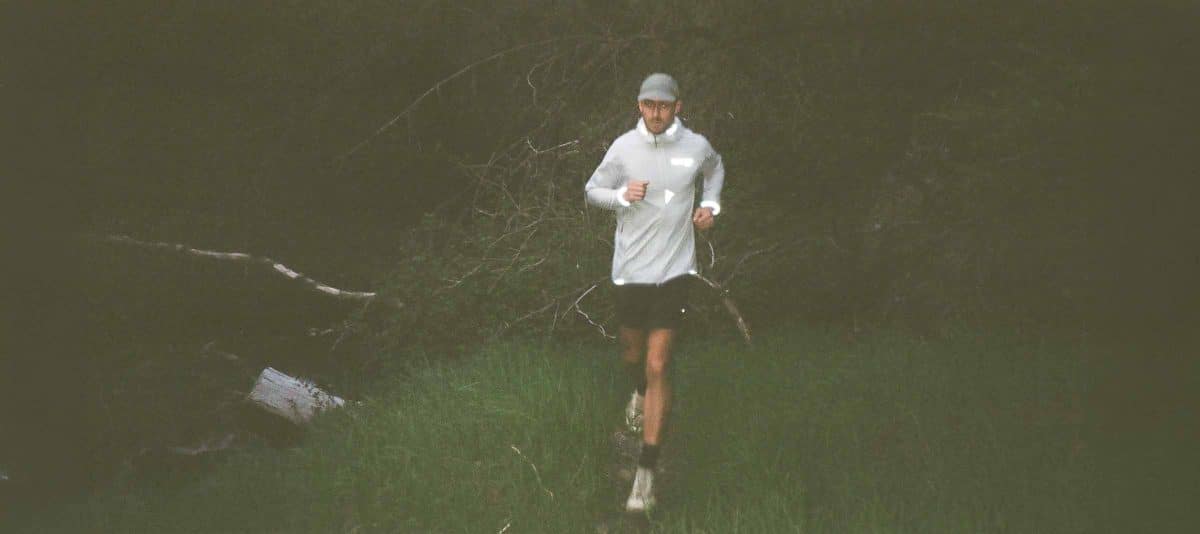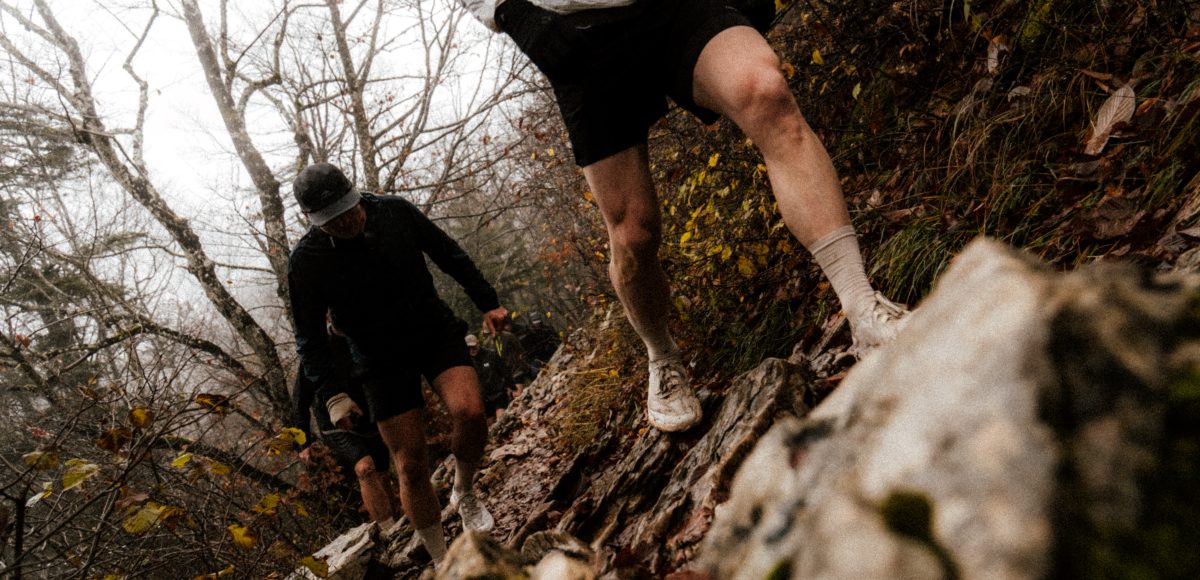
[These photos are from a mind-bending run we did with Norda and Quatorze in Annecy FR called Cabine 14.
Special thanks to the team at Quatorze and Norda who made it all possible. So much beautiful content from the day.]
Bear Chase 50 Mile
The time was 3:00 a.m. The alarm came too soon, but I didn’t sleep much anyway. The Bear Chase 50-mile trail race was just a few short hours away. I tried to be quiet; my crew—aka my wife and three kids—was still sound asleep in our hotel room.
I ate my standard pre-race breakfast of homemade vegan dark-chocolate waffles. And then I suited up.
norda 005
My norda 005s were already a palette painted by hundreds of miles on trail. They were race-tested, well-worn in, and only getting better. I couldn’t help but appreciate the craftsmanship that went into the design and build of the norda 005.
For a 50-mile race, there’s quite a bit of gear required to get you over the finish line, but it starts from the ground up.

The Day I Fell in Love with Footwear
I remember the day that I fell in love with footwear. No, not running shoes. In fact, not shoes at all in the traditional sense. I was in Sonoma County, California. My wife and I made the trip from Colorado to celebrate our anniversary and my completion of the bar exam. Sitting on the patio of Dutcher Crossing Winery and looking down the Dry Creek Valley, my attention was stolen by the gentleman who walked out from the tasting room. His boots were stunning. They looked like they had been to hell and back, and it was clear they weren’t done yet—not even close.
The patina of the Chromexcel leather wasn’t bought by its owner; it was earned. I was intoxicated. Not from the wine (for the most part), but from what I later discovered was his pair of Alden 403s—the iconic “Indy boot.” Go back and watch Raiders of the Lost Ark and check out Harrison Ford’s choice of footwear and you’ll know how the 403 earned its colloquial name. From that day forward, I was consumed by heritage handmade boots. My paradigm for how to dress properly changed in an instant.

Standing at the start line of The Bear Chase, my mind wandered backward to some pivotal moments from the past couple of years—the decision to quit drinking, a 2:53 marathon PR in Traverse City, Mich., my first mountain ultra at Speedgoat. I didn’t get here by accident. It was a series of small but intentional decisions stacked up day after day. It wasn’t necessarily planned, but before I knew it, I went from a casual runner into a serious endurance athlete. I didn’t know yet how the day would play out at The Bear Chase, but I knew that I had earned my spot at the line.
Soon after that day in Northern California, I quickly became an expert in heritage boots. I was fascinated by the tradition and craft of handmade bootmaking. While most shoes use cemented construction, heritage boots are built with a stitched welt joining the upper and the sole, allowing them to be rebuilt over time and better withstand the elements. Those Indy boots at Dutcher Crossing had clearly been resoled more than once.
The different leathers, lasts, and styles were equally alluring to me. I started to acquire a small collection—including the Aldens, of course—and I would often remind my wife of my new fashion mantra: “You always dress from the ground up.”

As I got deeper into the sport of trail running, it was only a matter of time before I discovered norda. Where the loud and overly branded look of most athletic shoes made me feel like I was putting on a costume, the nordas slotted in with a pair of selvedge denim as nice as my Viberg Service Boots. So when I learned that co-founders Willa and Nick Martire were lifelong shoemakers, it all made sense to me. And while the late miles of an ultra may be indifferent to fashion considerations, I quickly learned that from a performance perspective, norda was second to none.
Field Notes
The following field notes won’t read like a traditional shoe review. If that’s what you’re after, there are plenty of fine contributions already available on the norda 005 and 001A. Instead, enjoy my brief reflections of a special day at The Bear Chase, mixed with a couple of my all-time favorite heritage boots.
norda 005
The Bear Chase is a loop course. The 50-mile consists of four 12.5-mile loops. It’s advertised at 3,470 feet of elevation gain. My Garmin disagreed, putting it at 4,272. A loop course can cut both ways mentally. On one hand, you know exactly what you have in store on the last loop. On the other hand, you know exactly what you have in store on the last loop. For me, it was a good opportunity to stack the 005 against the brand-new 001A. My friends at norda were kind enough to send me a beautiful pair of 001As in Calcite.
The norda 005 was trail-tested for me. I knew exactly what I was going to get because I had already put several hundred miles on the current pair—including over 11,000 feet of climbing in the Wasatch Range of Utah. While the shoe performed well for me at Speedgoat, it was even more suited for The Bear Chase. With under 5,000 feet of gain on mostly groomed singletrack, the 005 was light and fast.
For road marathons, I always bought a new pair of race-day shoes. I wanted the aggressive toe-off and snap of a fresh carbon-fiber plate. But with the norda 005, it performed more like a pair of heritage boots. Sure, they looked nice out of the box, but they only got really good after you earned it. I stepped up to the line at The Bear Chase with more miles on my norda 005s than most of my daily trainers at their retirement age. The layers of dirt on the once-fresh Neve colorway were like the patina on a finely tanned leather.

Viberg Service Boot 2030
If the Alden Indy boot first introduced me to the world of heritage footwear, the Viberg Service Boot is where I understood what mastery looks like. Built in Canada by a third-generation family operation, it’s the boot that set the benchmark for what a lifetime piece should feel like. The 2030 last gives it a shape that’s both classic and confident—something between utilitarian and refined. There’s no pretense to it. Every stitch, welt, and edge feels intentional. My pair in Colour 8 Chromexcel has darkened and softened over time, the waxed pull-up leather catching light like polished mahogany. It’s not a boot you keep pristine; it’s one you live in.
Like the norda 005, it rewards use. The stitchdown construction means the upper is literally folded and stitched into the sole—a small mechanical detail that somehow captures an entire philosophy. These boots can be resoled, rebuilt, and worn for decades. I’ve worn mine through Colorado winters, client meetings, and long walks door-to-door on Halloween with the kids. Each scuff tells a story—my story.

norda 001A
Loop three on deck. Miles 25–37.5. My crew was waiting for me at the start line with a fresh pre-packed bag of gels, an oat-based bar, a Stumptown cold brew, and a bottle of electrolytes. I repacked my Raide LF 2L belt and refueled. My feet were damp, but not as wet as you might think given that there were three fully submerged water crossings per loop. The 005, with its open-mesh Dyneema upper and perforated microsuede tongue, evacuated water quickly. By the time I finished a loop, my feet were nearly dry.
I quickly put on fresh socks and laced up the 001A. They were fresh out of the box. Given that they arrived during my taper week, I hadn’t been able to get them out on the trail yet. Not ideal, but given the nature of the course, I figured I could run in just about anything for 12.5 short miles. Even though they were far from broken in, they didn’t disappoint.
The norda 001A may look identical to the 001 (one of my favorite shoes of all time), but after one loop at The Bear Chase, I can honestly say that it was an upgrade. Using a blend of norda’s Arnitel TPEE (the same foam used in the 005), EVA, and a proprietary third ingredient, the 001A was noticeably more responsive than its predecessor. It wasn’t quite as soft as the 005, but 25 miles in, the extra firmness gave my calves new life heading into loop three.


Briselblack Chelsea Boot – The Seventh
Some designs don’t need to shout to stand out. The Briselblack Chelsea, known simply as The Seventh, is one of them. Handcrafted in Bandung, Indonesia, by Adi Hermawan and his small team of bootmakers, it carries the quiet confidence of something built with care rather than scale. This was the first pair I ever custom-ordered—down to the smallest detail. Reverse black waxed horsebutt, red lining, white welt stitch, and a Dr. Sole Supergrip half sole. Every choice mattered, and every one of them felt like mine.
The wholecut design gives the boot an unbroken line from toe to heel, the kind of silhouette that doesn’t try too hard but still commands attention. The unstructured toe softens the look just enough, while the natural edge and black welt keep it grounded. Like my Vibergs, they’re made to last and meant to age, but The Seventh brings something else to the table—a sense of authorship. I didn’t just buy these boots; I built them. Or at least, I had a hand in the story they’ll tell.
The Final Loop
For the final loop I quick-changed back to the lighter—and drier—005s. My heavy legs appreciated the gesture. As I left, my wife softly said, “You’re in third place overall, first in your age group.” The news gave me a bit of urgency not to let up.
The wind picked up something fierce in the last five miles—so much so that by the time I reached the finish, volunteers were taking cover and holding down tents and equipment. It was an unceremonious finish with no one on the microphone, but that was okay. I finished right where I started the final loop—a podium for my first 50-miler and an earned sense of accomplishment.
My nordas performed brilliantly and now carry a part of the day I’ll never forget. The wind, the silence, the weight in my legs—it’s all still in them somewhere. That’s the thing about what’s built with care; it keeps a record. The shoes, the boots, the miles—they all remember what it took to get here.
They’ll dry out and clean up, but they’ll never really be the same—and that’s the point.